


The introduction of Artificial Intelligence into document management immediately raised questions about the system's accuracy and the plausibility of its answers. Today, thanks to rapidly evolving technology toward Intelligent Document Processing and AI agents capable of automating processes and guiding strategic business decisions, it's essential to be able to answer other questions, such as:
What information was that answer derived from? What version of the documents was used? Who approved those documents? What sources were retrieved by the system?
In short, true evolution isn't moving from documents to answers, but from answers to verifiable answers.
It's around these questions that the concept of Defensible AI is emerging: not a formally defined regulatory category or an international standard, but an increasingly useful way to describe AI systems whose results can be reconstructed, verified, and defended with evidence.
Explainable AI and Defensible AI: They're Not the Same
A system may be able to explain, at least in part, how it reached a given conclusion. But an organization may still be unable to demonstrate what evidence was available when that conclusion was reached.
This is an important distinction. Explainability primarily concerns understanding a model's behavior, while defensible AI pertains to the entire context in which that model was used: data, documents, versions, users, permissions, transformations, retrievals, outputs, controls, and subsequent decisions.
In other words, it's not enough to be able to say: "The AI produced this answer."
It should be possible to demonstrate: "The AI produced this answer on March 14th using these specific versions of these documents, retrieving these steps, with this version of the model and these instructions; the result was subsequently verified by this person and used in this process."
This is a fundamental difference.
The NIST AI Risk Management Framework explicitly links trustworthy AI to accountability and transparency, encompassing everything from design decisions and data to how decisions were made during and after deployment. It encourages organizations to document data provenance, including sources, origins, transformations, dependencies, and metadata.
The challenge isn't just to make AI smarter, but to make its relationship with information traceable.
Evidence Provenance: Where Does AI's Statement Come From?
The concept of provenance didn't originate with artificial intelligence, but when applied to document-based AI, this principle becomes particularly interesting.
A response generated by a business system should ideally preserve a true chain of evidence. If the source of the response is a document, it's necessary to identify its precise version, provenance, owner, acquisition date, any approvals, and any changes made over time.
The document can then be converted, OCRed, classified, segmented, enriched with metadata, or transformed into embeddings. The RAG system can then retrieve some of these segments and insert them into the context provided to the linguistic model. The model finally processes a response, which can be accepted, modified, or rejected by a human and, possibly, become the input for a subsequent workflow.
Provenance should ideally span this entire chain.
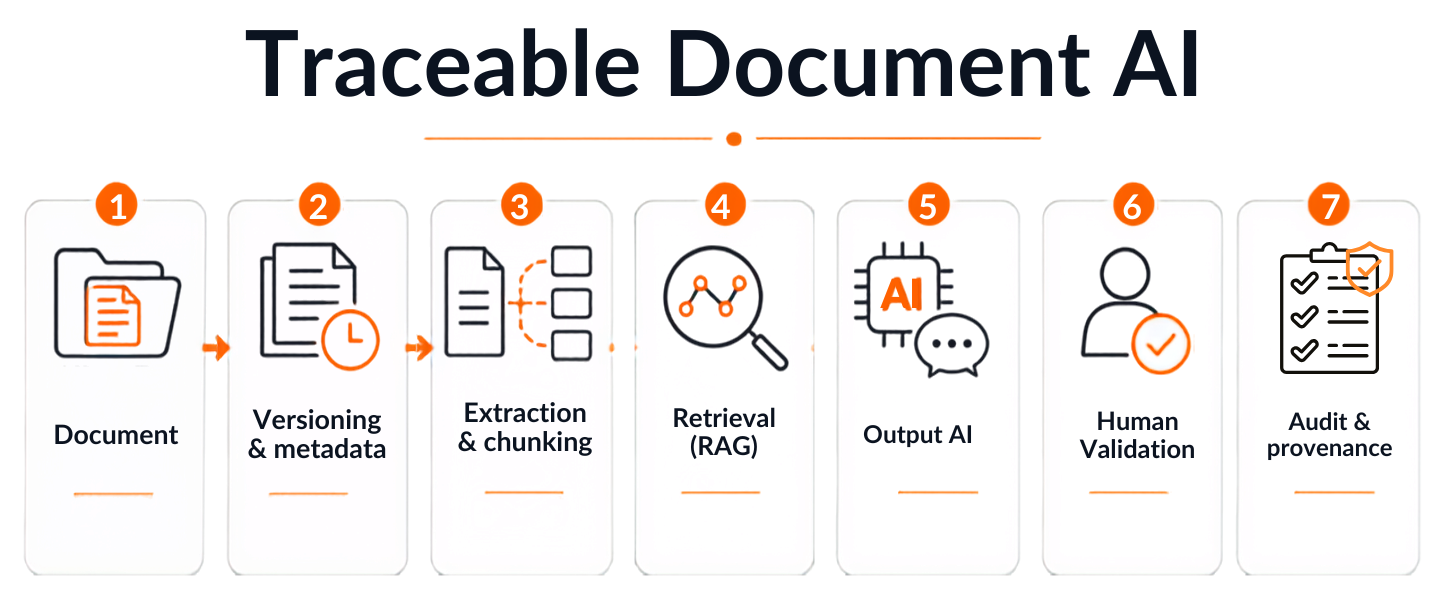
This is probably one of the most important differences between a simple generative AI application and a true Traceable Document AI.
RAG improves grounding. But it doesn't guarantee traceability.
Retrieval-Augmented Generation is often touted as one of the main solutions to the problem of hallucinations in Large Language Models.
The idea is relatively simple: instead of asking the model to respond solely on the basis of the knowledge contained in its parameters, the system retrieves information from a knowledge base and provides it as context for generation. But connecting an LLM to a document repository doesn't automatically make the system reliable.
The problem simply shifts. You need to know what the repository contains.
A RAG system can perfectly well retrieve the wrong document. It could mistakenly use an outdated procedure or retrieve a draft instead of the approved version. Deliberately manipulated documents could even influence it. (For more information)
In other words: RAG without document governance risks becoming simply a very efficient way to retrieve ungoverned information.
Versioning: A traditional DMS function becomes an AI governance function
Here an interesting paradox emerges. Some of the tools needed to govern advanced AI systems are not new at all.
Version control, for example, has been a fundamental function of document management systems for decades.
With AI, however, it takes on a different meaning. For a human user, it's often sufficient to know the current version of a document, while reconstructing a decision made by AI may require knowing the current version at a specific point in the past. Without versioning, that response becomes difficult to verify. And without the ability to associate retrieval and output with the actual version used, even a seemingly transparent RAG system can lose a crucial piece of its evidence.
Significantly, the NIST Research Data Framework considers versioning essential for data traceability, data reconstruction, change tracking, and error correction.
Audit trail: not just who modified a document
The same reasoning applies to the audit trail. Traditionally, a DMS records operations such as the creation, modification, download, approval, movement, and deletion of documents.
In an AI environment, the audit trail can become much broader, as we gradually move from a document audit trail to an AI evidence trail.
The former describes the document's history. The latter should connect that history to the decision's history.
This principle is very clearly reflected in the EU AI Act.
For systems classified as high-risk, Article 12 provides for the automatic recording of events throughout the system's lifecycle to ensure an appropriate level of traceability. Article 11 also requires updated technical documentation, while Articles 13 and 14 introduce requirements regarding transparency, interpretation of outputs, and human oversight.
From August 2, 2026, the Regulation became generally applicable, and the European Commission and national authorities assumed new enforcement powers. From this date, important transparency obligations under Article 50 also apply.
Naturally, not all AI-based document systems will fall into the high-risk category, and the framework is still progressive, with obligations waived and regulated between 2027 and 2028.
But this does not diminish the importance of traceability; on the contrary, it offers organizations an opportunity to design the necessary infrastructure before auditability becomes a problem to be resolved retroactively.
Document governance and AI governance are converging
Document management has often been seen as a discipline separate from artificial intelligence.
On one side are repositories, metadata, versions, permissions, workflows, and retention; on the other, models, prompts, vector databases, embeddings, and AI agents. This separation is becoming increasingly untenable. An enterprise AI system uses documents as operational evidence. Consequently, the quality of AI governance also depends on the quality of governance of that information.
Documents are no longer used solely by people. They are continuously read, classified, correlated, and retrieved by automated systems. For this reason, metadata, versioning, access control, and audit trails are no longer just administrative tools; they have become part of the organization's AI control plane.
In this scenario, a document management system can take on a much broader role than that of a simple repository. Platforms like LogicalDOC combine versioning, metadata, access control, audit trails, workflows, and AI-powered search and analysis capabilities. These elements can form the information foundation needed to build Document AI systems in which access to sources remains governed and, above all, traceable over time.
From the "single source of truth" to the "single source of evidence"
One of the main objectives of document management has always been to create a single source of truth: a reliable place to find accurate corporate information.
The arrival of artificial intelligence suggests a further evolution of the concept.
We could talk about a single source of evidence: not just the place from which AI retrieves information, but the system that can demonstrate what information existed, which version was valid, who was responsible for it, and how it was used.
The difference may seem semantic, but it is substantial.
A possible architecture for Traceable Document AI
In this scenario, the document repository should not be considered simply a source from which to extract text for transformation into embeddings.
It should remain the authoritative reference for the document.
The vector database can optimize retrieval. The linguistic model can interpret and generate. Agents can orchestrate activities. But alongside this pipeline, there must be a persistent chain that connects the output to the original evidence.
The more AI autonomy increases, the more important this chain becomes.
With a chatbot, an error can produce an incorrect response. With an AI agent, the same response can become the input for another operation: modifying a document, approving a case, starting a workflow, sending a communication, or updating a company system.
The evidence trail must therefore be able to follow not only what the AI says, but also what the AI does.
Provenance does not necessarily mean truth.
Finally, there is an important clarification. Provenance does not automatically prove that information is correct.
Rather, it demonstrates where it comes from and what happened to it; it means being able to identify the source of the error, determine which other outputs were affected, and correct the process.
Without provenance, however, the error risks becoming simply an incorrect response whose cause no one can reconstruct.
Enterprise AI's next challenge could be auditability.
In recent years, we've increasingly asked AI systems to classify, extract, understand, and generate.
Now we're starting to ask them to participate in decision-making processes and, with AI agents, even perform actions. This increased autonomy must be matched by greater auditability.
This is why the next qualitative leap in Enterprise AI may not simply be a more powerful model, but rather the ability to build systems in which every important decision maintains a verifiable link to the information on which it was built.
An organization that maintains reliable, versioned, governed, and auditable documents isn't simply managing its archive better; it's building the information infrastructure necessary for AI to be not only useful, but also traceable, accountable, and, when necessary, defensible.
Related Articles
Articles - Most Read
- Beyond Document Storage: How AI Turns Document Management into an Intelligent Business Engine
- RAG in Document Management Systems: Turning Enterprise Documents into Intelligent Knowledge
- AI-Native Document Processing: How IDP and Content-Centric Automation Are Transforming Document Management
- LogicalDOC 9.2.2 – Was ist neu? KI‑gestützte semantische Suche & erweiterte Sprachunterstützung
- Die wachsende Bedeutung des Multimedia-Managements in Dokumentenmanagementsystemen